

A fire alarm failure can quickly create a fire watch requirement for a commercial property. If you manage a commercial building, hospital wing, or active job site, you need to know exactly when fire watch is required because the applicable code or AHJ may set a specific response deadline.
If you manage a commercial building, hospital wing, or active job site, you need to know exactly when fire watch is required, because it turns from a search question into a legal deadline fast.
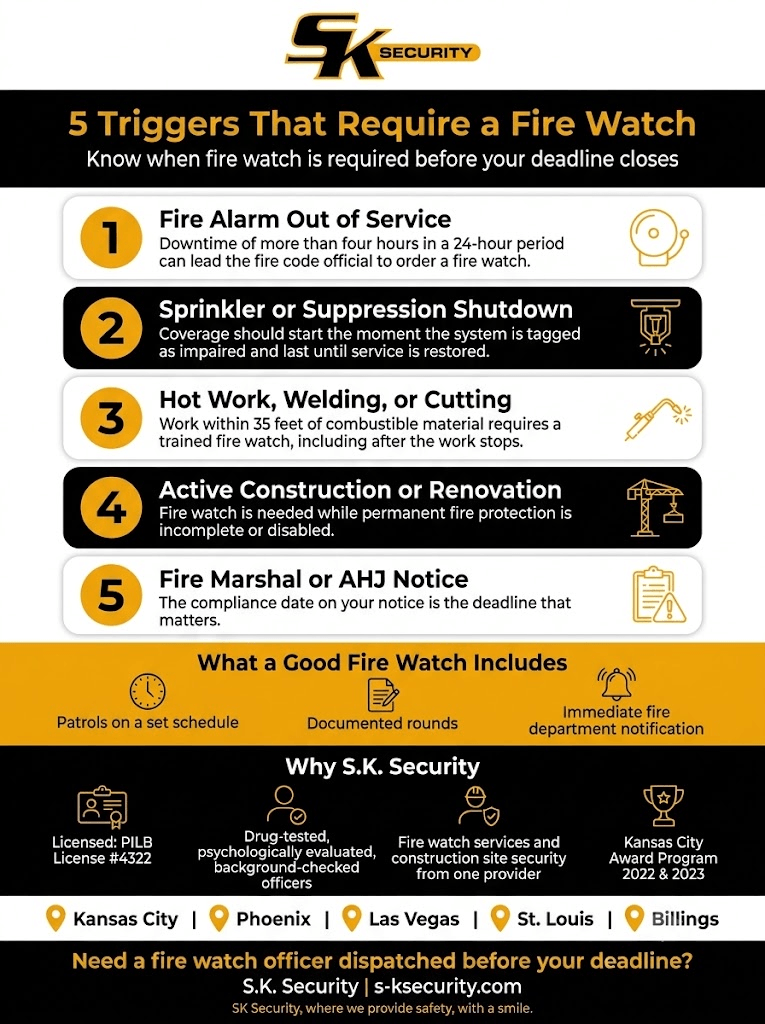
Below are five triggers that require a licensed fire watch company right now, along with the government code that makes each one non-negotiable.
Trigger 1: Your Fire Alarm System Is Out of Service
Knowing when fire watch is required starts with your alarm panel status, since this is the trigger most property managers miss.
• What the Code Requires
When your fire alarm system goes offline for more than four hours in a 24-hour period, your local fire code official has the authority to order a fire watch until the system is restored. This authority is written directly into municipal fire prevention codes, including the Kansas City Code of Ordinances.
A “minor” alarm glitch can quietly cross the four-hour threshold while you assume maintenance already has it handled. By the time you check, your compliance window may already be closing.
Kansas City’s own fire department has amended its fire alarm and detection system ordinance to keep this authority current, documented in the official city legislative record.
• What You Need to Do Next
Once your alarm technician confirms downtime will exceed four hours, you need a fire watch officer on-site before that window closes.
S.K. Security lists PILB License #4322 and provides psychologically evaluated, drug-tested, and background-checked officers for security assignments.
A compliant fire watch means a trained person patrols the affected area on a set schedule, documents each round, and notifies the fire department immediately if smoke or flame appears. If you wait until the fire marshal asks for proof of coverage, you are already out of compliance.
Trigger 2: Your Sprinkler or Suppression System Shuts Down
If you are asking when fire watch is required for a sprinkler outage, the answer runs on a different clock than your fire alarm.
• What the Code Requires
Once your sprinkler system is out of service for a defined impairment period, you need a supervised fire watch until service is restored. This requirement, and the patrol-logging standard behind it, is documented in official municipal fire watch guidance published by the City of Gainesville.
Hospitals, hotels, and apartment complexes with wet-pipe systems face this trigger most often.
• What You Need to Do Next
You need coverage that starts the moment your fire protection contractor tags the system as impaired, not the moment repairs finish.
Your fire watch officer should log patrol rounds at the interval your local fire marshal requires, since this documentation is what a fire inspector checks first. This keeps your building occupied and compliant while the impairment gets resolved.
Trigger 3: Hot Work, Welding, or Cutting Is Happening On-Site
Property managers rarely connect when fire watch is required for daily maintenance work, but hot work is one of the most common triggers on record.
• What the Code Requires
If your crew is welding, cutting, or brazing within 35 feet of combustible material, a fire watch is not optional. OSHA’s general industry standard requires a trained fire watch whenever slag, sparks, or heat transfer could reach a combustible surface, per 29 CFR 1910.252, available.
The same standard requires your fire watch to remain on-site for a set period after work stops. Smoldering material can ignite well after the torch is off, a point detailed in OSHA’s own hot work fire watch publication and confirmed in OSHA’s shipyard fire protection guidance.
• What You Need to Do Next
Your in-house crew is rarely trained to judge the true blast radius of sparks or to hold a post-work watch for the full required period. A dedicated fire watch officer stays focused on that single task, extinguishes small fires before they spread, and confirms the area is safe before signing off.
Trigger 4: Active Construction or Renovation on the Property
Understanding when fire watch is required also means watching your construction timeline, not just your finished building.
• What the Code Requires
Your construction or renovation site carries a higher fire risk because normal protection systems, standpipes, sprinklers, and alarms are often incomplete or temporarily disabled.
Fire watch coverage becomes necessary during phases when your permanent fire protection is not yet functional. Combustible debris, temporary heaters, and unsecured access all raise the stakes on an active site.
• What You Need to Do Next
You need a fire watch officer who understands construction sequencing, not just standing guard duty. S.K. Security already provides 24/7 construction site security against theft and unauthorized access, so adding fire watch coverage to that same site does not mean managing a second vendor or a second set of credentials.
Trigger 5: A Fire Marshal or AHJ Issues a Violation Notice
Sometimes when a fire watch is required, it has nothing to do with equipment failure at all.
• What the Code Requires
Your local fire marshal, known as the authority having jurisdiction, can order a fire watch for any condition identified as an immediate fire risk, even outside the scenarios above.
This discretion and the general definition of a fire watch are described in official government fire department guidance, including the City of Ames, Iowa, fire watch information page. The exact timeline printed on your notice is the deadline that matters, not a general industry average.
• What You Need to Do Next
Once your violation notice specifies a compliance date, you need licensed coverage in place before that date.
Most notices carry fines or occupancy restrictions for missed deadlines, so fast response matters more here than anywhere else on this list, because the fire marshal has already flagged your property as a priority.
How S.K. Security Approaches Fire Watch Service
When is fire watch required? That is only half the question. Who provides it matters just as much.
• Recognized for Best-Practice Security Programs
S.K. Security was selected by the Kansas City Award Program for demonstrating the ability to use best practices and implement programs that generate competitive advantages and long-term value, recognized in 2022 and 2023.
That kind of independent recognition reflects the same discipline your fire watch officer brings to every assignment, from documentation to conduct.
• Coverage Across Kansas City, Phoenix, Las Vegas, St. Louis, and Billings
S.K. Security provides security services across multiple service areas, including Kansas City, Phoenix, Las Vegas, St. Louis, and Billings.
Frequently Asked Questions
1: How fast do I need a fire watch after my fire alarm fails?
You need a fire watch in place before the four-hour impairment window closes, since that is the point where your alarm system is treated as non-functional under most adopted codes.
2: Can my own employees serve as a fire watch?
In some jurisdictions, trained employees can serve as a temporary fire watch, but they need the same training and patrol-documentation standards as a licensed officer. Most in-house staff do not meet this bar, which is why property managers hire a licensed provider instead.
3: Does a fire watch cost less than fixing the system fast?
Fire watch costs vary by location, staffing requirements, duration, and provider. It is generally a temporary safety measure while the underlying fire protection issue is addressed. Treat it as a short-term safeguard, not a replacement for repairing the impaired system.
4: What happens if I ignore a fire marshal’s fire watch order?
Ignoring an AHJ order can lead to fines, forced closure, or revoked occupancy permits, since the order confirms your local fire authority has already identified an active risk. Your compliance date is enforceable, not a suggestion.
5: Do construction sites need fire watch even with a security guard already on-site?
Your general security guard does not carry NFPA-aligned fire watch training or certification. Your construction site needs a fire watch officer specifically trained to monitor fire risk, separate from theft or access-control duties.
Conclusion
Every one of these five triggers carries a real deadline, whether that deadline is four hours, ten hours, or a date printed on a violation notice.
If any of these situations apply to your property right now, contact S.K. Security to get a licensed fire watch officer dispatched before your compliance window closes.