

When does a business need mobile patrol security instead of a stationary guard? Property managers ask this the moment they start comparing options and get conflicting answers from every provider they call. Providers may recommend different models based on property size, access points, staffing needs, and coverage requirements.
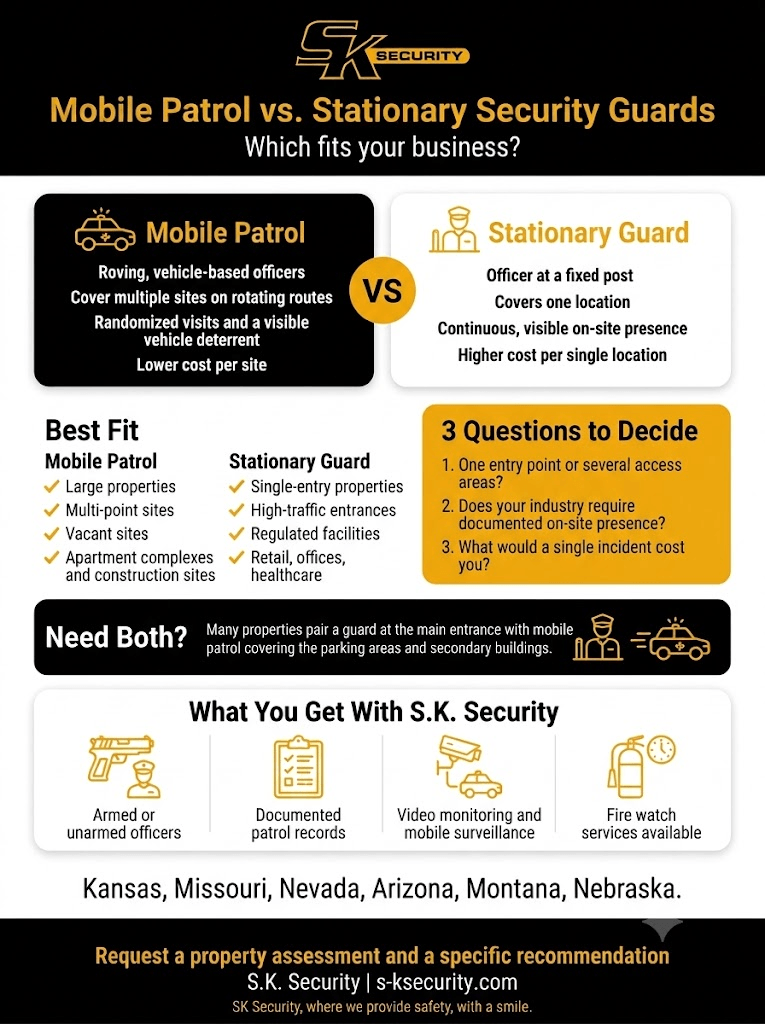
If you wonder when a business needs mobile patrol security, then mobile patrol security is used for roving, vehicle-based officers who check multiple locations on a rotating schedule, while stationary guards hold a fixed post for continuous, visible coverage.
S.K. Security runs both models across six states, so this comparison reflects real deployment decisions. By the end, you will know which service matches your property type, budget, and compliance needs.
Mobile patrol suits large, multi-point, or vacant properties that need cost-efficient coverage across several sites, while stationary guards suit single-entry, high-traffic, or regulated properties that need constant human presence.
Quick Comparison: Mobile Patrol vs Stationary Guards
Before you decide when a business needs mobile patrol security versus a stationary guard, look at how the two models stack up side by side.
• Reading the Comparison Table
The table below breaks down coverage, cost, and staffing differences.
| Criteria | Mobile Patrol | Stationary Guards |
| Coverage area | Multiple sites on rotating routes | One fixed location |
| Presence type | Randomized visits, visible vehicle deterrent | Continuous, on-site presence |
| Best-fit property | Multi-point, vacant, or low-occupancy sites | Single-entry, high-traffic, or regulated sites |
| Relative cost | Lower cost per site | Higher cost per single location |
| Officer credential | PILB License #4322 | PILB License #4322 |
• Licensing Standards Across Every State We Serve
S.K. Security lists PILB License #4322 officer status among its security credentials.
The Missouri Code of State Regulations 17 CSR 10-2.030 shows how the Kansas City Board of Police Commissioners classifies licensed personnel by duty, from unarmed watch services to armed protection.
In Nevada, the Nevada Private Investigators Licensing Board requires every private patrol officer to pass a background check under NRS 648.060.
In Arizona, the Arizona Department of Public Safety licenses private security guard services that provide patrol services and require fingerprint-based background checks.
In Montana, the Montana Board of Private Security requires each security guard applicant to complete a 16-hour training program and a fingerprint-based background check through the Montana Department of Justice and the FBI.
What S.K. Security Does Best (Mobile Patrol)
This is where the answer to when a business needs mobile patrol security becomes clear, and that is whenever a single guard cannot watch every entry point at once.
• Coverage Efficiency for Multi-Point Properties
A single mobile patrol officer checks several buildings, gates, and parking areas in one shift instead of watching one entrance all night. can follow varied patrol routes to make patrol timing less predictable. This fits apartment complexes and construction sites spread across a large footprint.
• Technology and Reporting Built Into Every Patrol
Every mobile patrol includes documented site inspections, giving you a record of when officers checked each location. S.K. Security pairs patrol routes with video monitoring and mobile surveillance units for extra visibility between checks.
S.K. Security was selected by the Kansas City Award Program for demonstrating the ability to use best practices and implement programs that generate competitive advantages and long-term value. The recognition covers 2022 and 2023.
• When Mobile Patrol Alone Is Not Enough
Mobile patrol does not replace a physical presence at a single, high-traffic entry point. A door that hundreds of people pass through daily has gaps between patrol visits that a stationary guard closes immediately. Properties with strict access-control needs, such as healthcare facilities or gaming floors, usually need a guard stationed on-site.
What S.K. Security’s Stationary Guards Offer
The flip side of when a business needs mobile patrol security is knowing when it does not, and that is where a stationary guard takes over.
• Best-Fit Property Types for Stationary Guards
A stationary guard fits properties with one main entrance, a lobby that needs constant monitoring, or a site where visitors must check in first. Retail stores, corporate offices, and healthcare facilities often choose this model because a single point of control needs a dedicated person watching it at all times.
• Armed vs. Unarmed Coverage Options
S.K. Security staffs stationary posts with either armed or unarmed officers depending on your property’s risk level. Unarmed guards handle standard property protection and access checks.
Armed officers cover higher-risk environments such as gaming floors or sites with a documented history of violent incidents.
The Kansas City Police Department’s private security licensing guidance confirms that unarmed officers are authorized to watch and report on premises, while armed officers must separately qualify for firearm authorization.
In Nevada, the Nevada PILB license booklet requires registered guards under a licensed patrol operator to pass a security guard exam with a perfect score.
S.K. Security was established in 2017 and serves clients across multiple states, giving clients a consistent staffing standard to rely on.
The Key Differences That Matter
Answering when a business needs mobile patrol security also means understanding what you give up by choosing it over a stationary guard.
• Presence vs. Coverage Radius
Yes, a stationary guard gives you someone at the door around the clock, but that guard cannot watch the loading dock, back fence, and parking structure at once. Mobile patrol trades constant presence at one spot for coverage across the whole property.
• Cost Structure
Yes, mobile patrol costs less per site because one officer serves several properties in a shift, but that efficiency means less time at any single location. Stationary guards cost more per site because you are paying for continuous presence, not shared coverage.
• Matching Risk Profile, Property Type, and Compliance Exposure to the Right Model
A comparison based only on cost and presence can miss other factors that affect the decision.
- First, does your property have one controlled entry point or several access areas across a larger footprint?
- Second, does your industry carry a compliance requirement, such as fire watch coverage, that demands a documented on-site presence?
- Third, what would a single incident cost you in lost inventory or liability exposure?
A single-entry retail store may be suited to a stationary guard, while a multi-building complex or a vacant construction site may benefit from mobile patrol. Properties with both conditions often need both services together.
Which Option Is Best for You?
If you are still weighing when a business needs mobile patrol security over a stationary guard, match your property to one of the two profiles below.
• Best Fit for Mobile Patrol
Mobile patrol works best for property managers overseeing large, multi-point, or vacant sites who need cost-efficient, randomized coverage across several locations.
• Best Fit for Stationary Guards
Stationary guards work best for businesses with a single high-traffic entry point, a regulated facility, or an event that needs constant, visible human presence. S.K. Security delivers both models across six states.
Frequently Asked Questions
These are the follow-up questions property managers ask right after they figure out when a business needs mobile patrol security for their site.
1: Is mobile patrol security cheaper than hiring a stationary guard?
Mobile patrol usually costs less per property because one officer serves multiple sites in a single shift. A stationary guard costs more per site since the shift covers only one property.
2: Can a business use both mobile patrol and stationary guards at the same property?
Yes. Many properties combine a stationary guard at the main entrance with mobile patrol covering the parking structure or secondary buildings.
3: Does mobile patrol security meet fire watch service requirements?
Mobile patrol alone typically does not satisfy fire watch requirements, which call for continuous, on-site monitoring. S.K. Security offers dedicated fire watch services for properties that need regulatory compliance coverage.
4: How often do mobile patrol officers check a property?
Your service agreement sets the patrol frequency based on property size, risk level, and site layout. Officers follow randomized routes within that schedule.
5: Is S.K. Security licensed to provide both patrol types?
Yes. S.K. Security operates under PILB License #4322, and every officer assigned to either service undergoes psychological evaluation and background checks and undergoes drug testing.
Conclusion
The short answer to when a business needs mobile patrol security is whenever your property has more ground to cover than a single fixed post can watch.
Choosing between mobile patrol and stationary guards comes down to your property layout, compliance exposure, and what a single incident would cost you if it went unnoticed. A single-entry office may benefit from a guard at the door, while a multi-building complex may benefit from patrol coverage across the whole perimeter.
Request a consultation with S.K. Security for a property assessment and a specific recommendation.