
Most property managers discover security gaps after a theft, break-in, or after-hours trespass causes damage. Static guards at one entrance cannot monitor large parking lots, secondary buildings, or loading docks at the same time.
In this article, we explain the benefits of mobile security patrols for commercial properties and what to look for in a licensed provider, so you can strengthen coverage before a security gap becomes a costly incident.
Quick Answer: Mobile patrols use marked vehicles and trained officers to move between checkpoints on a property, creating unpredictable coverage that static guards cannot match alone.
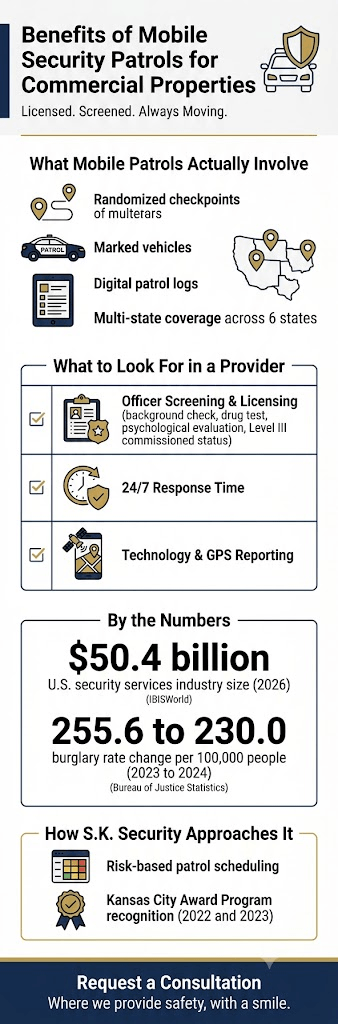
A mobile patrol officer drives a marked vehicle between scheduled and randomized checkpoints, checking the following:
Each visit is logged with a timestamp and observations, creating a clear record of what was checked and when.
This roving approach works well for commercial properties with multiple buildings, large parking lots, or several access points. One stationary guard cannot cover every area, while adding more guards quickly increases staffing costs.
S.K. Security provides mobile patrol coverage across six states, including Kansas, Missouri, Nevada, Arizona, and Montana. This allows multi-location property owners to use one patrol standard and reporting process across sites.
Demand for security services is also growing. According to IBISWorld, the U.S. private security services industry generated an estimated $50.4 billion in 2026.
Many property managers assume every mobile patrol service delivers the same level of protection. Patrol frequency, officer training, and reporting detail vary widely between providers. A lower price often means fewer checkpoints per shift or less detailed incident documentation.
Nonresidential burglary reports across major U.S. cities fell sharply through 2025, but that trend reflects markets with active deterrence measures already in place, not an argument for reducing coverage, according to the Council on Criminal Justice, Year-End 2025 Update.
A property that scales back patrol frequency to save cost can quickly become the exception to that trend.
Quick Answer: The right mobile patrol provider combines licensed and screened officers, fast response times, and real-time technology, not just a vehicle with a logo on it.
A patrol officer’s screening record matters as much as the patrol schedule itself.
Missouri’s private security regulations require officers to pass a written examination and meet qualification standards set by the Board of Police Commissioners before they can carry Level III commissioned status, according to the 17 CSR 20-2, Missouri Code of State Regulations.
The Kansas City, Missouri, Police Department also requires fingerprinting, photographing, and a background check for every private officer applicant before licensing, according to the Private Officers Licensing, KCPD.
S.K. Security officers are drug-tested, background-checked, and hold Level III commissioned status as required by law. Every officer also completes a psychological evaluation before assignment.
This screening depth matters directly to liability. An unscreened officer creates a new risk on the property instead of removing one, and the property manager carries that exposure if an incident occurs on their watch.
A patrol provider that only covers business hours leaves the riskiest hours unprotected: nights, weekends, and holidays, when a property is least likely to have anyone watching.
The national burglary rate fell from 255.6 to 230.0 incidents per 100,000 people between 2023 and 2024, but that decline still leaves hundreds of thousands of properties affected across the country every year, according to the Bureau of Justice Statistics, Crime Known to Law Enforcement, 2024.
Coverage during off-hours remains one of the clearest gaps a property can close. 24/7 mobile patrol coverage closes that gap. A property gains round-the-clock visibility without paying for a full-time stationary guard at every site.
Digital patrol logs, GPS-verified checkpoints, and video monitoring turn a patrol visit into a documented record. The provider creates a paper trail instead of offering a verbal assurance that the property was checked.
That record becomes evidence if an incident does happen. It supports both the insurance claim process and any liability defense the property manager may need later.
Quick Answer: S.K. Security builds mobile patrol schedules around each property’s specific risk pattern instead of running a single generic route for every client.
S.K. Security reviews a property’s incident history and access points before setting a patrol schedule. The team assigns checkpoint frequency and timing based on where and when risk is highest, rather than spacing visits evenly across the day regardless of actual risk.
Officers document every checkpoint visit and escalate anything unusual to the client directly. They do not wait for a scheduled report to surface the issue days later.
If a checkpoint reveals a propped door, a broken light, or an unfamiliar vehicle, the officer flags it immediately so the property manager can respond the same night instead of the next business day.
Patrol routes are also reviewed on an ongoing basis. If an incident pattern shifts toward a specific entrance or time window, S.K. Security adjusts checkpoint timing and frequency to match the new risk pattern instead of running the original schedule indefinitely.
This same review process applies across every state S.K. Security serves, so a multi-location client gets the same standard of adjustment at each site, not just the one a manager happens to be watching closely.
S.K. Security was selected by the Kansas City Award Program for demonstrating the ability to use best practices and implement programs that generate competitive advantages and long-term value. S.K. Security received this recognition in both 2022 and 2023.
Answer: Pricing depends on patrol frequency, property size, and how many checkpoints a route covers per shift. A property manager should request a proposal based on the specific site rather than comparing flat rates alone, since a cheaper quote often means fewer patrol passes.
Answer: A provider sets patrol frequency around the property’s risk pattern. Checkpoints follow randomized intervals, so the timing stays unpredictable to anyone watching for a routine. Higher-risk properties typically receive more frequent passes during overnight hours.
Answer: Not always. Large or multi-point properties often combine mobile patrol coverage with stationary or armed guards for high-risk zones, while smaller sites may only need roving coverage. The right mix depends on the property’s layout and incident history.
Answer: Yes. Licensed providers require officers to pass state qualification standards, including a background check, written examination, and psychological evaluation, before assigning them Level III commissioned status.
Answer: Yes. A provider can schedule mobile patrol alongside fire watch, healthcare, or gaming compliance coverage, so one company manages every regulatory need on a property instead of coordinating separate vendors.
The benefits of mobile security patrols depend on coverage that matches your property’s actual risks. Licensed officers, strategic patrol schedules, and detailed reporting help strengthen security across large or multi-location commercial properties.
Before choosing a provider, ask about officer screening, patrol frequency, and reporting standards.
Contact S.K. Security to create a mobile patrol schedule tailored to your property’s security needs.