
Property managers need to evaluate more than an hourly rate when hiring an access control security provider. Licensing, officer screening, response time, technology, and experience can all affect how effectively a provider manages access to a property.
The difference came down to what she asked before she signed a contract.
Before hiring an access control security provider, verify licensing, screening standards, response time, customization, technology integration, local knowledge, and track record. This article breaks down exactly what to ask for each.
Why These Seven Questions Matter Before You Sign
Understanding the benefits of access control security only pays off if the provider you hire actually delivers them, so a structured question list closes that gap.
Most business owners and property managers do not evaluate access control providers on price alone.
They compare two to three providers, check reviews, and confirm licensing before ever requesting a proposal. Skipping any one of these seven questions leaves a gap that shows up later, usually during an incident rather than during a routine inspection.
• What You Risk by Skipping This Checklist
A provider who cannot answer these questions directly usually has not thought through their own process, which means the risk lands on your property, not theirs.
How S.K. Security Approaches Access Control
Independent recognition is one of the clearest benefits of access control security done right, and it is worth verifying directly rather than taking a claim at face value.
S.K. Security was selected by the Kansas City Award Program for demonstrating the ability to use best practices and implement programs that generate competitive advantages and long-term value.
This recognition, the Achievement Award for Security Services, was awarded in 2022 and 2023, and it remains independently verifiable through the awarding body rather than a claim S.K. Security makes about itself.
• Why Independent Recognition Matters
Ask any provider for the specific name of an award, the issuing body, and the year, then verify it directly instead of accepting the claim as written.
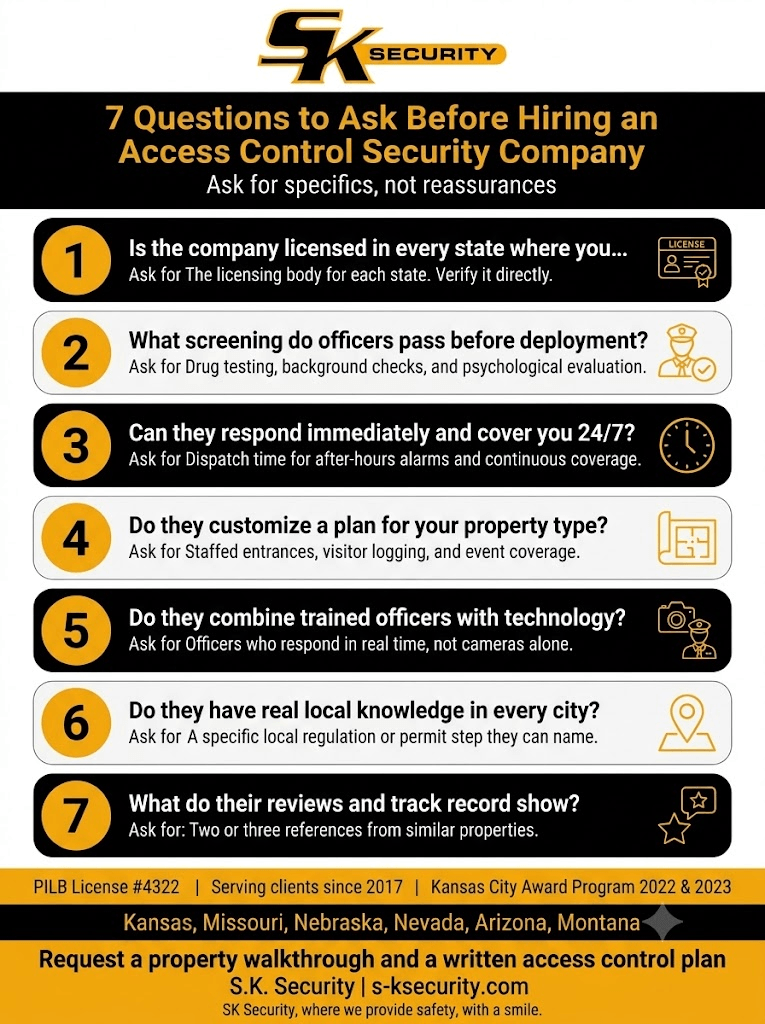
1. Is the Company Properly Licensed in Every State Where You Operate?
One of the most overlooked benefits of access control security is confirmation that the people managing entry points are legally authorized to do the job.
Licensing is the floor, not the ceiling. Every state, and even some cities, regulates private security differently.
In Kansas City, officers must be permitted through the Kansas City Missouri Police Department’s Private Officers Licensing unit, which requires fingerprinting, background checks, and a written exam.
In Phoenix, the Arizona Department of Public Safety issues separate security guard agency licenses under state statute.
In Las Vegas, the Nevada Private Investigators Licensing Board requires a criminal history background check through the FBI and the Nevada Department of Public Safety before issuing a license.
S.K. Security operates under PILB License #4322, authorized through the Kansas State Board of Police Commissioners with jurisdiction recognized by the Missouri Board of Police Commissioners.
Ask any provider to name their exact licensing body for each state where your property sits, not just their home market.
• How to Verify a License Claim
Call the licensing body directly using the contact information on its official website rather than relying on a number the provider gives you.
2. What Screening Standards Do Their Officers Pass Before Deployment?
A license confirms legal authorization to work, while screening standards confirm the officer is fit to be trusted on your property, which is one of the practical benefits of access control security worth checking twice.
A license tells you a company can legally operate. It does not tell you who they are sending to your building.
Ask whether officers complete drug testing, criminal background checks, and psychological evaluations before their first shift. Ask whether officers hold licensed status, which may involve additional training and licensing requirements depending on the jurisdiction.
• Red Flags in a Screening Answer
A vague response like “we screen everyone” without naming specific steps usually signals the provider has not documented its own process.
3. Can They Respond Immediately and Cover You 24/7?
Round-the-clock coverage is one of the benefits of access control security that only matters if the provider can actually deliver it after hours.
After-hours coverage can be important for properties with limited staff presence or access activity outside normal business hours.
Ask a provider what their dispatch time looks like for an after-hours alarm, and ask whether coverage is continuous or scheduled in blocks.
• Questions to Ask About After-Hours Gaps
Ask directly what happens between the last scheduled patrol and the first morning shift, since that window is where most gaps appear.
4. Do They Customize an Access Control Plan for Your Property Type?
A generic plan cancels out the benefits of access control security, since an apartment complex and a construction site need different entry strategies entirely.
A gated apartment community has different entry points, visitor patterns, and risk profiles than a downtown office tower or an active construction site. Ask whether the provider builds a property-specific plan or applies the same checklist to every client.
• What a Customized Plan Should Include
A real plan names which entrances are staffed, how visitors are logged, and how coverage changes during events or after-hours deliveries.
5. Do They Combine Trained Officers With Access Control Technology?
The strongest benefits of access control security come from pairing cameras and credential systems with an officer who can act in real time, not from technology alone.
Answer nugget: Access control systems can combine electronic technology with trained officers to monitor and respond to entry activity. Cameras and badge readers can record who passed through a door, but they cannot physically stop someone who tailgates behind an authorized visitor or intervene when a credential is used by the wrong person.
A provider should be able to explain how their officers monitor entry points alongside any technology in place, not just how the technology works on its own.
• What to Ask About Visitor Logs and Tailgating Prevention
Ask exactly how visitor entries are logged, who reviews the log, and what an officer does when someone follows an authorized person through a controlled door without checking in.
• Why Cameras Alone Do Not Replace an On-Site Officer
Video systems can document activity, while an on-site officer can respond to access issues in real time. Ask a provider how many of their contracts include a physical officer versus a camera-only setup, and ask why.
6. Do They Have Real Local Knowledge in Every City You Operate?
Multi-state experience is one of the benefits of access control security that only counts if the provider’s local knowledge is genuine in every market, not just their home base.
Genuine local knowledge shows up in the regulatory details a provider can name without hesitation.
In Montana, the Department of Labor and Industry’s Private Security Program requires a minimum of 16 hours of training before a security guard license is issued. Statewide in Missouri, Missouri Senate Bill 1273 requires 30 hours of classroom training and a written exam for security guard employees.
In the greater St. Louis area, the St. Charles County Security Professional Licensing Program sets baseline age, background, and drug-testing requirements for every armed and unarmed officer.
S.K. Security has operated across multiple states, including Kansas, Nebraska, Missouri, Nevada, Arizona, and Montana, since the company was established in 2017. Coverage maturity varies by market: Kansas City is the company’s home base with the strongest local presence, while newer markets like Billings are still growing their footprint.
• How to Test Local Knowledge in an Interview
Ask a provider to name a specific local regulation or permitting step in your city, since a real local presence can answer this without hesitation.
7. What Do Their Reviews and Track Record Actually Show?
A clean track record is one of the more visible benefits of access control security, but it should be checked alongside reviews and direct references, not treated as the only proof needed.
Reviews and references reveal how a provider performs day to day, beyond any single award or credential. Ask for two or three references from properties similar to yours, and ask what happened the last time something went wrong. A provider that only offers generic testimonials without specific examples has not been tested the way your property will test them.
• Questions to Ask a Provider’s References Directly
Ask the reference how the provider handled an actual incident, not just how satisfied they are in general.
Frequently Asked Questions
These answers cover the questions buyers ask most often after reviewing the seven core vetting questions above.
1: How long does it take to set up access control security at a new property?
Setup timelines depend on property size and the number of entry points that need staffing or technology integration. A provider should walk the property, identify each access point, and propose a plan before quoting a start date rather than giving a generic estimate upfront.
2: Is licensed access control security more expensive than an unlicensed provider?
Licensed providers typically cost more upfront because licensing, psychologically evaluated, drug testing, background checks, and skilled training all carry real costs. An unlicensed or under-screened provider may quote lower, but the buyer carries the liability risk if an unqualified officer causes or fails to prevent an incident.
3: Can one provider cover multiple properties across different cities?
Some providers operate in a single market only, while others maintain licensing and staffing across several states. Confirm the provider holds active licensing in every city where you need coverage, not just their headquarters location.
4: Do access control officers replace the need for cameras and badge systems?
No. Officers and technology work best together. A badge system records entries, but an officer can verify identity in person and respond immediately if something looks wrong.
Conclusion
Choosing an access control provider requires more than comparing prices. Licensing, screening, response capabilities, technology, and local requirements should all be reviewed before signing a contract.
Use these seven questions with every provider on your shortlist, ask for specifics rather than reassurances, and request a property walkthrough before signing anything.
• Your Next Step
Request a property walkthrough and a written access control plan from S. K. Security before signing any contract.