
Access control problems rarely start as emergencies. They often begin with repeated gate-propping, unauthorized visitors, or access rules that tenants ignore. For property managers searching for access control security guard services, these patterns can signal a growing security risk.
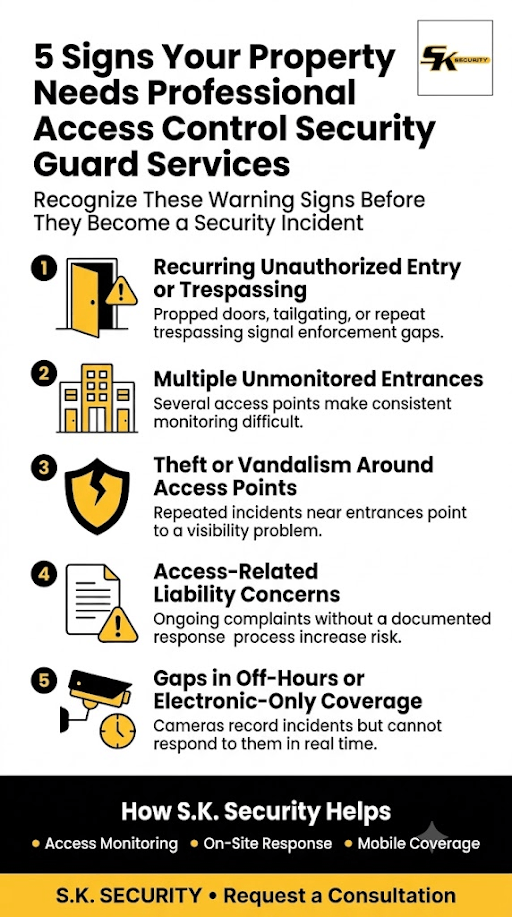
In this article, we cover five signs that your property may need professional access control security guards instead of relying on cameras or automated systems alone. We’ll also explain what each warning sign can mean for your property’s security and liability.
Access control issues can expose a property to unauthorized entry, theft, disputes, and safety concerns. The warning signs are often easy to overlook when they happen repeatedly without causing an immediate incident.
Recognizing these patterns early can help property managers determine when professional security guard support is needed.
Repeated unauthorized entry is one of the clearest signs that a property’s existing access controls are not being consistently enforced. Propped-open doors, tailgating, unauthorized visitors, and repeat trespassing can turn an isolated incident into a recurring security problem.
The national property offense rate fell 9% from 2,019.7 per 100,000 people in 2023 to 1,835.1 per 100,000 in 2024, according to the Bureau of Justice Statistics. Burglary also declined from 255.6 to 230.0 per 100,000 during the same period.
These national figures do not predict what will happen at an individual property, but they provide useful context when evaluating local security risks.
Properties with documented, recurring access violations that existing locks, cameras, or electronic access systems have not stopped.
Repeated incidents do not automatically mean a property needs full-time security guards. The frequency, severity, location, and required response time should determine the appropriate level of coverage.
A property becomes harder to monitor when visitors, vendors, deliveries, and tenants can enter through several doors, gates, loading areas, or parking entrances. The problem becomes more serious when people regularly bypass the property’s check-in or identification procedures.
For example, a camera may record someone entering through an unsecured side door, but it cannot ask the person why they are there or prevent them from proceeding. A trained officer can verify access, enforce the property’s entry procedures, and respond when someone cannot establish authorization.
Apartment communities, office buildings, retail centers, industrial properties, and other sites where multiple entrances make consistent access enforcement difficult.
Not every entrance needs a permanently stationed officer. Depending on the property layout, scheduled patrols, mobile coverage, or strategically staffed access points may provide sufficient coverage.
Repeated theft or vandalism near entrances, parking areas, gates, or restricted areas can indicate that a property has an access or visibility problem.
If incidents repeatedly occur where unauthorized people can enter or move through the property without being challenged, management should examine how those areas are controlled.
The BJS reported that the national property offense rate was 1,835.1 per 100,000 people in 2024, including rates of 230.0 for burglary, 1,334.5 for larceny-theft, and 270.6 for motor vehicle theft.
The motor vehicle theft rate recorded the largest decline among those three categories, falling 19% from 2023 to 2024.
Properties where security incidents repeatedly occur around entry points, parking areas, gates, or other locations where controlling movement is difficult.
Security guards are only one part of a theft-prevention strategy. Lighting, locks, cameras, fencing, signage, and property design should also be addressed where appropriate.
A property may need stronger access control when management is repeatedly dealing with security complaints, documented access failures, or concerns about whether reasonable security procedures are being followed.
These concerns can become more difficult to manage when there is no consistent person responsible for monitoring and documenting access activity.
The warning sign is not simply having a security complaint. It is a pattern in which access problems continue without a reliable process for identifying visitors, responding to violations, and documenting what happened.
Property managers who need documented enforcement of access procedures and a defined on-site response when those procedures are violated.
A security guard cannot eliminate liability by simply being present. Property owners and managers should establish clear access policies, maintain the physical security of the property, and consult qualified legal or insurance professionals about specific liability concerns.
A camera can record an access violation, but recording an incident is different from responding to it while it happens. Properties with significant activity during evenings, overnight hours, weekends, or holidays may need a person available to verify access and respond to problems.
The need for trained security personnel also exists across a large national workforce. The Bureau of Labor Statistics projects about 423,600 openings each year, on average, across protective service occupations from 2024 to 2034, largely because workers leave these occupations and need to be replaced.
Properties that need consistent access enforcement or an on-site response during evenings, overnight periods, weekends, or other high-risk operating hours.
Full-time coverage is not always necessary. A property may benefit from scheduled patrols, mobile security, or coverage during specific high-risk hours instead of maintaining a guard on-site around the clock.
S.K. Security combines licensed Level III commissioned officers with video monitoring and mobile patrols to provide a layered approach to access control. This allows properties to combine technology with trained personnel who can make decisions and respond when an access violation occurs.
Officers are stationed or patrolling key entry points while video monitoring and mobile surveillance provide additional coverage where the property needs it.
Property managers who need a documented, on-site response to access attempts rather than relying solely on recorded footage.
Manned access control works best alongside the property’s existing cameras, locks, entry systems, lighting, and access policies rather than replacing those measures entirely.
Answer: If a property has repeated unauthorized entry, multiple unmonitored entrances, or theft near access points, these are direct signs that current coverage is not enough. A pattern across more than one of the seven signs above is a strong indicator that licensed, on-site guarding is the next step.
Answer: Cameras record what happens at an access point but cannot physically stop or question someone in the moment. A licensed security officer can verify identity, deny entry, and respond immediately, which closes the gap that recorded footage leaves open.
Answer: Yes. S.K. Security operates under PILB License #4322, issued under the Kansas State Board of Police Commissioners with Missouri Board of Police Commissioners’ jurisdiction, and every uniformed officer is Level III commissioned, drug-tested, and background-checked before deployment.
Answer: Yes. S.K. Security offers around-the-clock coverage options, including mobile patrol and on-site guarding, for properties that need consistent access oversight outside standard business hours.
Recurring access violations, unmonitored entrances, theft, and off-hours gaps can indicate that cameras and electronic systems are not enough. Security guard access control services add trained personnel who can verify access and respond to problems in real time.
Contact S.K. Security today to discuss your property’s security needs and request a consultation.