
Most property managers know security matters, but fire watch requires a specific, dedicated role. A fire watch guard monitors for fire risks during hot work or when fire protection systems are impaired.
In this guide, you’ll learn what a fire watch guard does, when fire watch may be required, and what to look for when choosing a provider.
Quick Answer: A fire watch guard provides dedicated fire-risk monitoring during hot work or fire protection system impairments, helping properties meet applicable safety and compliance requirements.
Quick Answer: A fire watch guard maintains uninterrupted visual monitoring of a property, logs conditions at set intervals, and takes no other assignments during the watch period.
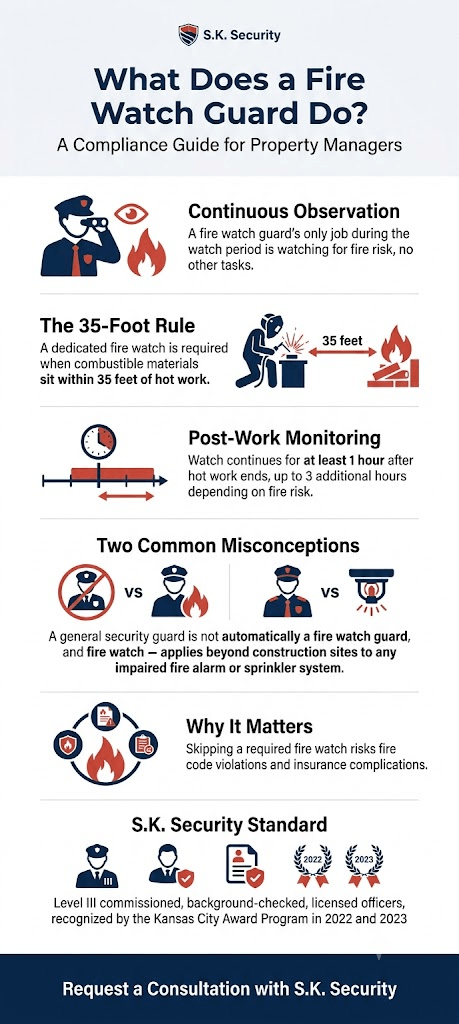
A fire watch guard continuously monitors hot work activities for signs of fire and responds to potential hazards without taking on other assigned duties during the watch period. OSHA guidance describes fire watch as a dedicated safety responsibility during applicable hot work operations.
This is not a walking patrol that checks in every hour. Dedicated, uninterrupted observation defines the role, and providers like S.K. Security assign Level III commissioned, licensed officers specifically for this duty rather than pulling from general patrol staff.
A fire watch guard has more responsibilities than simply watching for smoke or flames.
Under OSHA’s 29 CFR 1910.252 standard, fire watch may be required during certain welding and cutting work when combustible materials are within 35 feet of the work area. It may also apply when sparks can travel through openings in floors or walls.
The guard keeps fire extinguishing equipment nearby and monitors the area for signs of fire. The guard must also stay on-site for the required period after hot work ends.
OSHA and NFPA 51B set specific fire-watch requirements for applicable hot work. The exact monitoring period depends on the standard and the conditions of the work area.
A fire watch guard should not leave the site early or take on unrelated duties during the watch. The assignment requires dedicated attention to fire hazards.
Quick Answer: Skipping a required fire watch creates direct exposure to fire code citations, insurance claim denial, and preventable property loss.
When a fire suppression or alarm system goes out of service, or when hot work begins, the fire watch requirement is not optional guidance. This obligation ties directly to occupancy permits and insurance conditions.
A missed or incomplete fire watch can leave a property manager facing a fire code violation on top of any actual fire damage, and insurers routinely reference compliance gaps when reviewing claims tied to preventable incidents.
A documented fire watch gives property managers a clear compliance record: start and end times, patrol intervals, and equipment checks. That record matters during an insurance review, a fire marshal inspection, or a tenant liability dispute.
A well-documented watch turns an invisible safety task into evidence the property was managed responsibly.
Quick Answer: A fire watch guard is a distinct, code-driven role, not an extension of general security patrol or a construction-only requirement.
A general security officer patrolling a property does not meet the fire watch standard unless that officer is specifically assigned, trained, and dedicated solely to fire watch duties for the required period. Splitting attention between general security tasks and fire watch responsibilities does not satisfy the code.
Fire watch requirements also apply any time a building’s fire alarm or sprinkler system goes out of service for maintenance or repair, regardless of whether construction is happening.
A hospital, apartment complex, or office building with an impaired system needs the same dedicated coverage as an active job site.
Quick Answer: S.K. Security’s fire watch officers meet the same Level III screening standard applied across every assignment, and the company holds independent recognition for its operational standards in Kansas City.
S.K. Security was selected by the Kansas City Award Program for demonstrating the ability to use best practices and implement programs that generate competitive advantages and long-term value, earning recognition in 2022 and 2023.
That record reflects the same operational discipline applied to every fire watch assignment across S.K. Security’s multi-state service area, including Kansas City, Las Vegas, Phoenix, and St. Louis.
Quick Answer: These answers cover the duration, exclusivity, and legal triggers of a fire watch guard assignment, along with S.K. Security’s coverage area.
Answer: Under NFPA 51B, fire watch may need to continue for at least one hour after hot work ends. Additional monitoring may be required based on the fire risk of the area. The guard should remain on-site until the required watch period is complete.
Answer: No. Fire watch requires a dedicated officer with no other assigned tasks during the watch period. Combining fire watch with general patrol or front-desk duties does not meet the compliance standard.
Answer: A fire watch is required during hot work near combustible materials and whenever a building’s fire alarm or sprinkler system goes out of service. Both situations carry the same coverage obligation regardless of building type.
Answer: The property risks a fire code violation, potential insurance claim complications, and unmanaged fire risk during the exact window when the building’s normal fire protection is weakest.
Answer: Yes. S.K. Security provides fire watch coverage across its full multi-state service area, including Las Vegas, Phoenix, St. Louis, Wichita, and surrounding markets.
Answer: A qualified fire watch guard should hold verified licensing, complete background screening, and receive specific training on fire watch duration and monitoring standards, not just general security training.
A fire watch guard provides dedicated monitoring when hot work or an impaired fire protection system creates added risk. The right coverage helps protect your property and supports applicable fire safety requirements.
If you need fire watch coverage, contact S.K. Security today to discuss your property’s needs and schedule licensed fire watch services.