

When you search for security options for your property, you find dozens of opinions and no clear answer. Some guides push you toward building an internal team. Others insist outsourcing is always cheaper. You need a clear comparison of how security patrols deter crime, along with the real cost and liability factors involved, not marketing claims.
You already know that visible, roving coverage can be useful, and how security patrols deter crime is part of that picture. The bigger budget question is who manages that patrol function: your own payroll or a contracted provider.
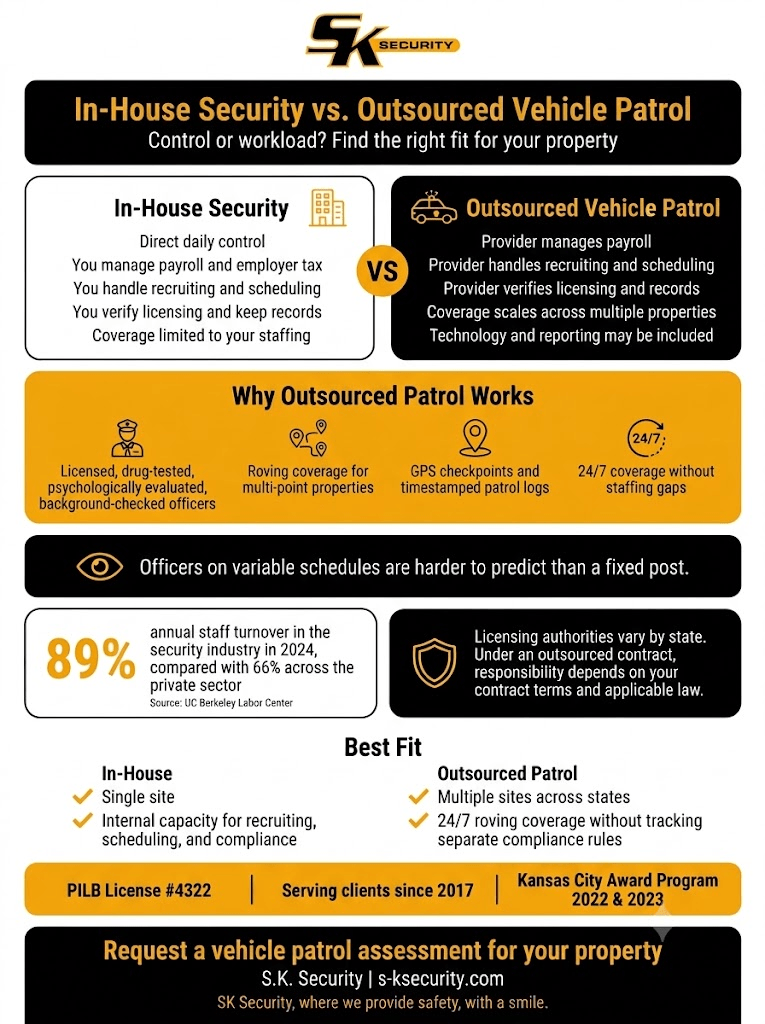
In-house security versus outsourced vehicle patrol comes down to control against workload: in-house gives you direct daily control but full staffing responsibility, while outsourced vehicle patrol shifts, recruiting, licensing verification, and scheduling are done by the provider.
That trade-off matters most for properties with multiple sites or limited internal capacity. This article explains how staffing, licensing, compliance, coverage, technology, and ongoing management responsibilities can affect the choice between the two models.
Quick Comparison: In-House Security vs. Outsourced Vehicle Patrol
The two models differ most in who carries the day-to-day management burden and who absorbs coverage gaps when someone calls in sick.
| Factor | In-House Security | Outsourced Vehicle Patrol |
| Payroll and employer tax | Managed directly by your business | Managed by the provider |
| Recruiting and scheduling | Your responsibility, ongoing | Provider’s responsibility |
| Licensing and compliance tracking | You verify and maintain records. | The provider verifies and maintains records. |
| Coverage flexibility | Limited to your staffing capacity | Scales across multiple properties |
| Technology and reporting | You source and manage tools. | May be included depending on the provider and contract |
What Outsourced Vehicle Patrol Does Best
Outsourced vehicle patrol works best when your property needs consistent, licensed coverage across multiple points without the burden of building a security department from scratch.
• Licensed, Screened Officers Reduce Your Compliance Burden
Outsourced vehicle patrol services put licensed, drug-tested, psychologically evaluated, and background-checked officers on your property without adding them to your payroll.
S.K. Security provides licensed officers for roving security coverage, depending on the service arrangement, so your team is not responsible for recruiting, scheduling, or verifying credentials for every shift.
That responsibility shifts to the contracted provider, which stays accountable for keeping every officer current and compliant, and demand for that role is projected to keep growing according to the U.S. Bureau of Labor Statistics.
• Roving Coverage Built for Multi-Point Properties
If your property spans a large footprint, such as an apartment complex, a construction site, or a multi-building commercial campus, a single stationed guard cannot realistically cover every access point.
Vehicle patrol officers move between checkpoints on a set or risk-based schedule, checking parking areas, entry points, and vulnerable zones that a static guard would have to leave unattended to reach.
How security patrols deter crime comes down to unpredictability: an officer moving between checkpoints on a variable schedule is harder to anticipate than a fixed post, which changes the calculation for anyone considering an unauthorized entry.
• Technology and Reporting Included in the Service
Many outsourced vehicle patrol contracts include GPS-verified checkpoints, timestamped patrol logs, and incident-reporting tools as part of the service, rather than as equipment your team has to source and maintain separately.
That visibility lets you review exactly when and where each patrol occurred without setting up your own monitoring system.
• 24/7 Availability Without Staffing Gaps
Building 24-hour coverage in-house means recruiting enough staff to fill nights, weekends, and holidays, plus backup coverage for absences.
An outsourced patrol contract already accounts for round-the-clock scheduling as part of the service, which can help reduce the chance that a single callout or vacancy does not leave your property without planned coverage.
S.K. Security was recognized by the Kansas City Award Program with an Achievement Award for Security Services in 2022 and 2023 for “demonstrating the ability to use best practices and implement programs that generate competitive advantages and long-term value.”
That recognition reflects the operational consistency a 24/7 patrol contract is built to deliver.
What In-House Security Involves
Running security in-house means your business handles recruiting, background checks, training, scheduling, and licensing compliance directly, with no outside provider absorbing that workload.
• The Day-to-Day Responsibilities You Take On
You carry the payroll tax, benefits, and turnover costs yourself, and any coverage gap from an absence or vacancy becomes your problem to solve immediately.
Federal payroll tax obligations alone, including income tax withholding, Social Security, Medicare, and FUTA, add administrative work outlined in the IRS Employer’s Tax Guide, on top of licensing renewals and shift scheduling your internal team must manage.
The Key Differences That Matter
The real difference between these two models is not just price. Who absorbs the ongoing management work, and who carries the risk when something goes wrong, is what actually separates them.
• Yes, In-House Gives You Full Control, But That Control Has a Cost
In-house security gives you direct oversight of every guard on your payroll, but that control comes with a workload that requires ongoing recruiting, scheduling, and compliance management.
The security industry’s annual staff turnover reached 89 percent in 2024, far above the 66 percent private-sector average, according to the University of California, Berkeley Labor Center.
For an in-house team, a high turnover rate can mean recurring recruitment and retraining needs. An outsourced provider handles those staffing responsibilities under the terms of the service agreement.
• Who Actually Carries the Liability Risk, and It Varies by State
Most guides comparing security staffing models stop at hourly rates and skip the liability question.
The real decision is about who owns responsibility if a licensing lapse, an unscreened hire, or an incident-reporting gap causes a problem on your property, and the licensing authority changes depending on where your property sits.
In Kansas City, that means the Board of Police Commissioners, as outlined by the Kansas City Police Department’s Private Officers Licensing Unit.
In Las Vegas, it means the Nevada Private Investigators Licensing Board, operating under Nevada Revised Statutes Chapter 648.
Under an in-house model, your business carries that licensing and insurance responsibility directly in every state where you operate. Under an outsourced patrol contract, the provider may handle certain licensing and insurance responsibilities, but the exact allocation depends on the contract and applicable law.
Which Option Is Best for You?
Your property size, staffing capacity, and risk exposure determine which model fits, not a blanket rule about cost.
• Best-Fit Scenarios
In-house security best fits property teams with a single site and existing internal capacity to manage recruiting, scheduling, and compliance directly on an ongoing basis.
Outsourced vehicle patrol best fits property managers and operations leaders overseeing multiple sites across different states who need licensed, 24/7 roving coverage without tracking separate compliance rules in each market.
Frequently Asked Questions
1: Is outsourced security more expensive than hiring in-house guards?
In-house staffing includes costs beyond hourly pay, such as recruiting, training, and managing coverage during turnover. The security industry reported an annual staff turnover rate of 89% in 2024, according to the cited UC Berkeley Labor Center research.
2: Who is responsible for licensing when you outsource vehicle patrol?
The contracted provider is typically responsible for verifying and maintaining each officer’s licensing status, though the exact requirement depends on the state licensing board where your property is located.
3: Can a property switch from in-house security to a patrol contract mid-year?
Yes, contract flexibility varies by provider. Review the available short-term, project-based, and long-term options before making the switch.
4: What should be in an outsourced vehicle patrol agreement?
A solid agreement should specify officer licensing verification, insurance coverage, patrol frequency, and incident-reporting procedures.
5: Does hiring a licensed patrol provider reduce my property’s legal risk?
It can reduce certain risks, such as unlicensed staffing, but it does not eliminate all liability automatically, since your insurance and contract terms determine how responsibility is shared.
Make the Right Call for Your Property
Choosing between in-house security and outsourced vehicle patrol comes down to how much staffing management your team can absorb versus how much coverage your property needs.
Understanding how security patrols deter crime can help you evaluate coverage quality, while knowing who manages that coverage helps you assess the staffing and liability responsibilities involved.
If you manage multiple locations or need reliable 24/7 roving coverage, request a vehicle patrol assessment from S.K. Security and get a coverage plan built around your specific risk profile.