
When you need security for an aviation property, choosing the right provider matters. A general guard company may cover routine security needs, but aviation-related properties can require a more tailored approach.
In this article, we compare private airport security with general guard services to help you choose the right fit for your property.
Quick Answer: General security companies can suit standard commercial properties, while aviation-focused security may be a better fit for properties with aviation-related assets and access requirements.
Quick Answer: The two options differ most in officer screening depth, technology integration, and how directly the provider’s training maps to aviation environments.
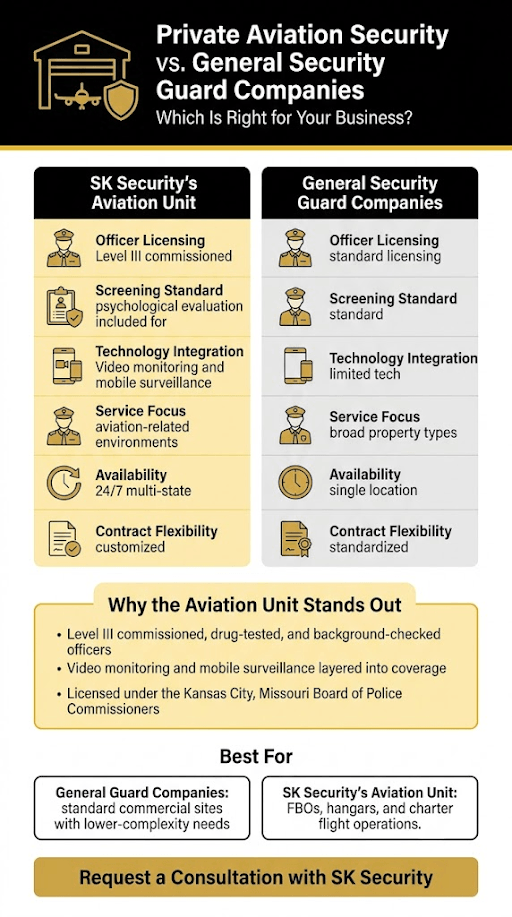
| Criteria | SK Security's Aviation Unit | General Security Guard Companies |
|---|---|---|
| Officer licensing | Level III commissioned, drug-tested, background-checked | Varies by provider and state |
| Screening standard | Psychological evaluation included | Not always included |
| Technology integration | Video monitoring and mobile surveillance units | Often limited to basic patrol |
| Service focus | Aviation-related environments alongside other confirmed service lines | Broad property types |
| Availability | 24/7 across multiple states | Varies by contract |
| Contract flexibility | Customized per property | Often standardized packages |
S.K. Security states that its officers hold Level III commissioned status and undergo drug testing, background checks, and psychological evaluations before assignment. This company-wide screening standard provides property managers with a defined benchmark when evaluating private security services.
The Kansas City, Missouri, Board of Police Commissioners has authority under RSMo Section 84.720 to license and regulate private security personnel operating in the city. This licensing structure gives clients a way to verify officer credentials rather than relying solely on a provider’s claims.
S.K. Security received the Kansas City Award Program’s Achievement Award for Security Services in both 2022 and 2023. The recognition reflects the company’s stated approach to security services and provides an additional indicator for businesses evaluating its experience and operating standards.
S.K. Security also offers video monitoring and mobile surveillance alongside its security personnel. These services can provide additional visibility beyond traditional foot patrols, depending on the property’s security requirements and selected coverage.
The TSA’s 2025 General Aviation Security Guidelines identify security considerations for general aviation facilities, including access control and protection of aircraft and other assets.
For properties with aviation-related security needs, combining trained personnel with appropriate surveillance technology can provide broader coverage than relying on a single security measure.
S.K. Security provides security services across multiple U.S. markets, including Kansas, Missouri, Nevada, Arizona, and Montana. Businesses with properties in several of these markets can evaluate whether using one provider would simplify security management across their portfolio.
When comparing private airport security providers, look beyond broad service claims. Consider the officer licensing and screening standards, available surveillance technology, service locations, and the provider’s demonstrated experience.
For aviation-related properties, these factors can help you determine whether a provider’s capabilities align with your property’s specific security requirements.
General security guard companies can be a practical choice for businesses that need dependable protection across common commercial and residential environments.
These providers typically offer a range of services designed to address routine security needs across different property types.
General security guard companies commonly provide services such as:
They may serve retail stores, office buildings, apartment complexes, and other facilities that require ongoing monitoring and protection.
Licensing requirements vary by state and jurisdiction, so businesses should confirm that their selected provider meets the rules applicable to their property.
In Nevada, for example, private patrol officers are regulated under Nevada Revised Statutes Chapter 648, which establishes requirements for private security services.
The main difference is the type of environment each provider is equipped to address and how closely its services match the property’s specific security requirements.
A general security company may be a practical choice for properties that need routine patrols, access control, or general asset protection. However, businesses with aviation-related security requirements should also evaluate whether a provider has relevant experience and capabilities.
Rather than choosing based solely on the number of services a company offers, compare the provider’s licensing standards, personnel qualifications, surveillance capabilities, service experience, and ability to tailor coverage to the property’s security requirements.
The right security provider depends on how closely its services, training, and experience align with the specific risks of your property.
The main difference between general security providers and aviation-focused services is how closely their capabilities match the environment they protect. Both may provide trained security personnel, but their experience and service models can differ based on the types of properties they routinely serve.
General guard companies offer coverage across many property types, which can be useful for businesses with varied security needs. However, a provider serving retail, residential, office, and other commercial properties may not have the same specialized experience with aviation-related environments.
Standard security training prepares officers for common responsibilities such as access control, patrols, incident reporting, and property monitoring. These skills remain important, but aviation-related properties may require additional consideration based on their layout, access points, aircraft, equipment, and other assets.
For properties such as hangars, FBOs, or charter operations, businesses should evaluate whether a security provider has the personnel, technology, and experience needed for the specific environment. A provider’s ability to tailor its approach to the property’s risks can be just as important as the basic security services it offers.
The right choice depends on the property’s risk profile and the type of security coverage required. General security services may be sufficient for standard commercial properties, while aviation-related operations may benefit from a provider with capabilities that align more closely with their environment.
General security guard companies are best for property managers running standard commercial sites, such as retail stores, offices, or apartment complexes. They are a practical choice for businesses that need coverage for common, lower-complexity security needs.
S.K. Security’s Aviation Unit may be a better fit for businesses with aviation-related security requirements. It can suit operators looking for experienced security personnel and additional surveillance capabilities tailored to their property’s needs.
Answer: Aviation-related properties often involve specialized access points and higher-value assets. A provider with Level III commissioned officers and full background screening brings a standard suited to that exposure.
Answer: No. SK Security operates across Kansas, Missouri, Nevada, Arizona, and Montana, applying the same Level III standard company-wide.
Answer: If your property includes an FBO, hangar, or charter flight operation, its access points and asset exposure call for a provider with aviation-related experience. A standard retail or office patrol package is not built for that exposure.
Answer: Every officer completes drug testing, a background check, and a psychological evaluation before holding Level III commissioned status. This applies to any property, including flight-related sites.
Answer: SK Security offers customized contracts, including long-term, short-term, and project-based options. Coverage can be scoped to a single event or an ongoing schedule.
The right security provider should match your property’s risks, layout, and operational needs. General security services can provide effective coverage for standard commercial properties. Aviation-related properties may require a more tailored approach to access control, surveillance, and asset protection.
If your business needs private airport security or aviation-related security services, S.K. Security can help you assess the right level of coverage for your property. Contact S.K. Security today to discuss your security needs and request a customized consultation.