
Before most property managers choose an aviation security provider, they compare quotes based on hourly rates alone. It seems like the fastest way to control costs.
That approach can overlook compliance requirements, officer qualifications, and liability considerations. This article breaks down exactly how to choose an aviation security provider for an airport, FBO, or private terminal, using the same criteria experienced buyers already apply.
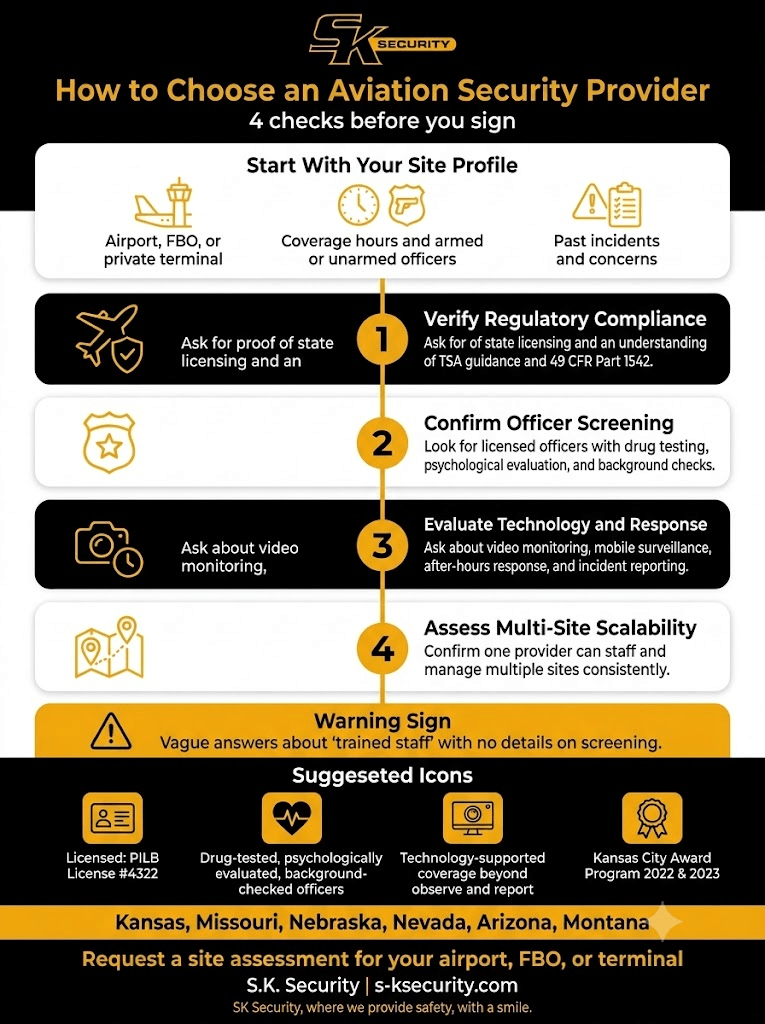
Choosing an aviation security provider and knowing what aviation security includes comes down to four checks: regulatory compliance, officer screening standards, technology and response time, and the ability to scale across sites.
What You Need Before You Start Evaluating Providers
If you are still asking what aviation security includes before you request a single quote, start with your site profile first. Put together a short summary of the property you need protected.
Note whether it is a commercial airport, a fixed-base operator, or a private terminal, since each carries different regulatory obligations. List your required coverage hours, whether you need armed or unarmed officers, and any existing incidents that shaped your current concerns.
• Requirements, Conditions, and Information Needed
Ask every security vendor you contact for proof of state licensing before the conversation goes any further. Ask each security vendor for proof of applicable state licensing before moving forward with the evaluation.
Kansas state law requires anyone operating as a private security guard or private security agency to hold an active license issued by the state, with applicants meeting minimum age, citizenship, and character requirements before approval.
S.K. Security holds PILB License #4322 under the Kansas State Board of Police Commissioners, with jurisdiction recognized by the Missouri Board of Police Commissioners, and this is the type of documented credential you should expect from any provider you consider.
The Four-Step Evaluation Process for a Security Partner
Understanding what aviation security includes also means knowing how to judge the company delivering it. The right security firm satisfies four specific checkpoints, not just a general sense of professionalism.
A provider that meets all four gives you a defensible, compliant security program instead of a guess dressed up as a guard contract.
• Step 1: Verify TSA and 49 CFR Part 1542 Regulatory Compliance
Confirm that any company you consider understands the federal framework that governs airport and aviation-adjacent security work.
The Transportation Security Administration publishes General Aviation Security Guidelines that outline security expectations for aviation-related operations, and airport operators regulated under 49 CFR Part 1542 must maintain an approved security program covering personnel identification, access control, and training.
The Federal Aviation Administration further requires that airports subject to 49 CFR Part 1542 maintain access control standards even during construction, including secured gates and identification of contractor personnel entering restricted areas.
A provider should understand the applicable federal and airport-specific security requirements before working in an aviation environment.
• Step 2: Confirm Officer Screening, Licensing, and Training Standards
Ask exactly how officers are vetted before deployment. Federal oversight records show that individuals granted unescorted access to secured airport areas are required to undergo a fingerprint-based criminal history records check and hold an approved security clearance before badging.
S.K. Security officers are licensed, psychologically evaluated, drug-tested, background-checked, and hold licensed officer status as required by law, which reflects the same screening depth expected of anyone with access to sensitive aviation environments.
Vague answers about “trained staff” without specifics on drug testing, psychological evaluations, background checks, or commissioning status are a warning sign, not a selling point.
• Step 3: Evaluate Technology Integration and Response Time
Ask whether the provider uses technology such as video monitoring, mobile surveillance, or coordinated dispatch to support its on-site officers.
TSA guidance on automated airport badge and credential systems recommends real-time tracking of access media as a best practice for reducing unauthorized entry risk.
Ask how quickly officers can respond to an incident after hours, and ask what technology backs up the officers physically on-site. Ask, too, how incidents are documented and escalated, since a provider without a clear reporting chain leaves you without evidence when it matters most.
• Step 4: Assess Multi-Site and Multi-State Scalability
If your operation spans more than one location, confirm the company can actually staff and manage multiple sites without losing consistency.
S.K. Security operates across six states, including Kansas, Missouri, Nebraska, Nevada, Arizona, Montana, and surrounding areas, which supports property managers who need one vendor across multiple airports, FBOs, or terminals instead of juggling separate regional contracts.
When This Becomes a Job for a Professional Aviation Security Provider
Once you know what aviation security includes on paper, the harder question is whether your current staffing can actually deliver it. Once your site carries regulatory exposure, after-hours risk, or multi-location complexity, in-house staffing may require additional resources for compliance, training, scheduling, and oversight.
• Signs Your Airport, FBO, or Terminal Needs Licensed Aviation Security Now
If your facility is subject to a TSA-approved security program, operates outside standard business hours, or has experienced unauthorized access in the past, in-house or unlicensed staffing can create additional compliance and liability considerations.
Government audits have found that lapses in badge and access media tracking directly increase the risk of unauthorized airport access, underscoring why consistent oversight matters more than headcount alone. These are not situations to manage with a stopgap solution.
• How This Standard Is Met in Practice
S.K. Security was selected by the Kansas City Award Program for demonstrating the ability to use best practices and implement programs that generate competitive advantages and long-term value, recognized through the Achievement Award for Security Services in 2022 and 2023.
That recognition reflects an approach built on licensed, psychologically evaluated officers, drug testing, psychological evaluation, background checks, and technology-supported coverage rather than the traditional “observe and report” model.
Frequently Asked Questions
Buyers researching what aviation security includes usually have a few follow-up questions before they request a quote. The answers below cover the most common ones.
1: What does aviation security include?
Aviation security typically includes access control, perimeter patrol, video monitoring, and compliance with federal regulations such as 49 CFR Part 1542 for airport operators. It also includes officer screening standards like background checks, psychological evaluation, and drug testing, since personnel integrity is as much a part of aviation security as physical patrol coverage.
2: Is aviation security regulated by the TSA?
Yes. The Transportation Security Administration sets baseline expectations for aviation-related security operations, and airport operators must maintain a security program approved under 49 CFR Part 1542. Any provider working in this space should be able to explain how their staffing and procedures align with these federal requirements.
3: How much does an aviation security provider cost?
Cost depends on coverage hours, whether you need armed or unarmed officers, and whether technology such as video monitoring or mobile patrols is included. The final cost can also depend on your site’s compliance requirements, staffing needs, and technology requirements.
4: Can one provider cover multiple airport or terminal locations?
Some companies can, but multi-state capability varies significantly. Ask directly how many states or regions a provider currently serves, and request examples of how they maintain consistent training and reporting standards across locations before signing a multi-site contract.
5: What is the difference between armed and unarmed aviation security?
Armed officers are typically licensed and trained for high-risk environments, while unarmed officers handle standard access control, patrol, and monitoring duties. The right choice depends on your site’s risk profile, regulatory requirements, and the specific vulnerabilities identified during your evaluation.
Choose an Aviation Security Partner With Confidence
Knowing what aviation security includes only helps if you use it to evaluate the company standing in front of you.
Choosing the right provider comes down to verifying regulatory compliance, confirming real screening standards, checking technology and response capability, and making sure the “how to choose an aviation security provider” process ends with a company that can scale with your operation.
If your airport, FBO, or private terminal needs a licensed, multi-state security partner that meets these standards, request a site assessment from S.K. Security to review your specific coverage needs and compliance requirements.