
Multi-location properties can develop security gaps between patrol visits, leaving managers exposed to theft, vandalism, or tenant complaints. Mobile patrol security helps close those gaps by using trained officers and marked vehicles to monitor multiple properties on scheduled or randomized routes.
In this article, you’ll learn how mobile patrol security works, what to look for in a multi-location provider, and how S.K. Security coordinates coverage across different service areas.
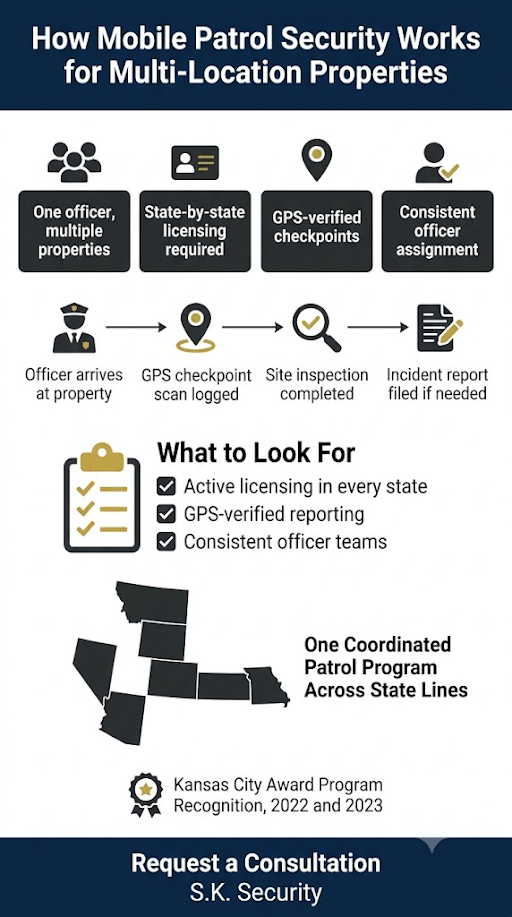
A mobile patrol program combines scheduled or randomized routes, GPS-verified checkpoints, and centralized incident reporting so one officer can cover several properties in a single shift.
A mobile patrol officer travels between assigned properties in a marked vehicle, stopping at each location to inspect key areas before moving to the next site. During each visit, the officer may check the following:
The officer records each visit using a GPS-verified checkpoint system. This creates a timestamped record that property managers can review and helps confirm that scheduled patrols were completed.
If the officer finds a security concern, they document the issue and follow the agreed incident-reporting process. This creates a clear record of what was observed and when.
Mobile patrol provides visible deterrence and documented checks across multiple properties. However, it is not a substitute for a stationary security officer when a property requires continuous, on-site coverage at a busy entrance or other high-traffic area.
Many property managers schedule patrol visits at the same time every day, which makes the pattern predictable to anyone watching the property. A fixed schedule also means every site gets checked at once, leaving no coverage between visits if an incident happens during the gap.
Randomized visit windows and staggered routes across a multi-site portfolio close that predictability problem.
Property crime declined 12.4 percent nationally in 2025, with burglary down 15.8 percent, according to the FBI’s, 2025 Reported Crimes in the Nation, a trend tied in part to more visible and less predictable deterrence patterns.
The right multi-site provider proves licensing in every state involved, uses GPS-verified checkpoints, and keeps the same officers assigned to your properties.
State governments issue private security licenses, not the federal government, so a provider operating in Kansas is not automatically authorized to patrol a property in Nevada or Arizona.
Before signing a multi-location contract, ask the provider to confirm active licensing in every state where a property sits, not just the state where the company is headquartered.
Checkpoint reporting should give a property manager a single dashboard or report showing every stop, timestamp, and note across all locations, not a separate paper log per site.
This matters most for portfolios spread across cities, since a manager reviewing coverage from a central office needs consistency, not five different reporting formats from five regional teams.
Rotating officers through unfamiliar properties slows down incident recognition, since a new officer does not know what looks normal at a site they have not patrolled before.
Ask whether the provider assigns a consistent officer or small team to each property in the portfolio, rather than dispatching whoever is available that shift.
S.K. Security operates mobile patrol services under active licensing in Kansas, Missouri, Nevada, Arizona, and Montana, which lets one company coordinate a single patrol schedule across a property portfolio instead of the client managing separate vendors in each state.
This unified structure keeps checkpoint reporting, officer assignment, and incident response consistent no matter which state a property sits in.
Every state security board sets its own licensing, training, and commissioning requirements, which means a security company expanding into a new market has to requalify its officers under that state’s rules before a single patrol vehicle can legally operate there.
S.K. Security holds active licensing in each of the six states it serves, so a property owner with sites in Kansas City and Las Vegas gets one coordinated patrol program instead of piecing together separate local vendors with different reporting formats and response standards.
That single point of contact is the detail most mobile patrol providers do not explain, because most companies operating across state lines still manage each market as a separate, disconnected contract.
S.K. Security was recognized by the Kansas City Award Program in 2022 and 2023 with an Achievement Award for Security Services for its use of best practices and programs designed to deliver long-term value.
The company applies the same operating standards across its service areas, helping maintain consistent security practices for properties in Kansas City and other locations it serves.
Answer: Patrol frequency depends on the property type and risk level, but most commercial and multi-family properties receive between two and six documented checks per shift.
A property manager should set the frequency during onboarding and adjust it based on incident history rather than using a single default schedule for every site.
Answer: Yes, but only if the company holds active licensing in each state where a property is located, since private security licensing does not transfer across state lines.
S.K. Security maintains active licensing across Kansas, Missouri, Nevada, Arizona, and Montana, which allows a single coordinated patrol program to cover a portfolio without the property owner managing separate vendors in each market.
Answer: The officer documents the issue at the checkpoint and notifies the property manager through the agreed reporting channel, then escalates to local law enforcement if the situation involves an active threat or crime in progress.
S.K. Security includes the incident in the next reporting cycle so the property manager has a written record.
Answer: A stationary guard covers one site continuously, while a mobile patrol officer covers several sites on a scheduled or randomized route, which lowers the cost per property for portfolios where full-time staffing at every location is not practical.
86 percent of security professionals report positive business conditions, according to the Security Industry Association, Security Market Index, July-August 2026, reflecting steady industry confidence in this coverage model.
Mobile patrol security helps multi-location property managers maintain consistent, documented security across multiple sites without staffing every property around the clock.
Contact S.K. Security today to discuss vehicle patrol services for your properties and create a coordinated security plan.